Ancestral Ground
regenerative, just futures are possible
Welcome to Ancestral Ground!
We are so glad you found this project, dedicated to lifting up diverse practices of ancestral reconnection with an explicit anti-racist and liberatory lens, undertaken by U.S. practitioners of European descent. A growing movement of powerful work is happening across the country – both newly emerging and longstanding – that bridges white anti-racism with ancestral recovery.
Ancestral Ground aims to highlight the bridges between the worlds of Euro-descended ancestral reconnection and the political, ecological, cultural and spiritual dimensions of anti-racism. This project provides a virtual community space to grow perspectives, expressions and connections within this vibrant landscape.
FIRST EDITION IS LIVE!
Welcome to the inaugural edition of Ancestral Ground – a vibrant, multi-genre collection of poetry, essays, speculative fiction, visual art, interviews, practices, and songs, weaving together the many ways people are engaging at the intersection of ancestral recovery and anti-racism work. Think of this space as a digital apothecary: a place to learn and unlearn, grapple and be inspired, find roadmaps and medicine as we heal from the erasures of whiteness and harms of white supremacy, reclaim the wisdom, beauty, and power of our ancestral lineages, and build a more just and regenerative future together.
We invite you to take your time with these offerings, let them work on and change you, and bring the inquiry into community using our Dialogue & Practice Guide – because none of us is meant to make this journey alone! You will find all of the featured pieces living in each of the thematic sections on the site. Deep gratitude for our ancestors and all the contributors who have made this edition come alive.

Virtual Launch Event
Inaugural Edition

ICE’s Surge in Metro MN Awakens New Vision of Cultural Solidarity in European Americans
This submission explores how people of European descent woke up and rose up to act in solidarity with the Immigrant communities in Minneapolis.. This experience was an initial rekindling for many white people of the understanding of unity consciousness, our ancient wisdom, that has been terribly fragmented and replaced with colonizer culture that keeps us in separation consciousness. This piece was written in Feb. 2026. Now in Sept. 2026, solidarity and unity consciousness continues to nourish our local diverse community.

Bulbancha Festa di San Giuseppe
A multi-year, multidisciplinary art project and ritual that began as a response to the Italian American community's support of memorializing Columbus. It is an invitation for deep, collective liberation work for people of the Italian and Sicilian diaspora and beyond.

Toward Collective Liberation
Chris Crass dives into the need for white people to bring positive, liberatory leadership in our communities, groups, and efforts. Leadership to help white communities get free from the nightmare of white supremacy and join in broad-based movements to defeat authoritarianism and advance multiracial feminist democracy.

Building Liberatory Futures Within Precarity: Practices of Ancestral Recovery & Why They Matter for White People Today
This co-authored piece offers an overview of the foundational practices and apprenticeships orienting the Re-Calling Our Ancestors team's framework of ritual inquiry in ancestral recovery, truth-telling, and collective repair.

our origins as a nation are right here
This is a brief story published in a local paper that I wrote in reflection about the repair work my family was engaged in this year in Webster Groves, MO. This piece reflects on how the stories we tell matter, and what it means to tell the story of our nation in its 250th year.

ReStorying Boca: Reckoning with Ancestral Debt Along the Truckee River
This story explores the entrepreneurial history of my great-great-grandfather in the ghost town of Boca at the turn of the 20th century, and traces this legacy to today's ecological crisis. During a visit to Boca, along the Truckee River, I examine the hidden costs of an economic system divorced from nature's regenerative cycles. By soundly acknowledging my family's and settler society's indebtedness to Native people and their occupied homelands, I add my voice to the growing movement to unravel and reweave the tattered fabric of this country– one thread, one family story, at a time.

Ancestors of Place
I feel strongly that until we do the work of acknowledging, reconciling with, and working to heal the harm in our lineages, we continue carrying that harm into our own lives. There are also well ancestors in all of our lineages—even if very far back in time—that are worthy of our attention and care. It is by a stroke of well-timed luck that I was able to explore the places mentioned in my essay, but visiting ancestral homelands isn’t the only way we can heal our lineages. I hope my experience sheds some light on the joys and complications of connecting with ancestors can help us be better allies.

Reconnecting to our white anti-racist ancestors as a portal to all of our people
We share two pieces from our collaborative, creative white anti-racist project, honoring the Coffins and the Partisans, with visual art by Leah Jo and poetry by Caroline. We share some framing and some inquiries of how practices of cultivating relationships with chosen white anti-racist ancestors might strengthen our ability to relate to our blood ancestors in their wholeness, and help us be braver and more human in these times of empire and collapse.

Cultivating Wholeness
From 2019-2022, we served as the tenders of the “white branch of humanity” for the Decolonize Race Project. This writing is our effort to capture how this experience reshaped us and our relationship to our whiteness. We extend deep gratitude to all of our Decolonize Race colleague friends, and to all of the white people who participated in the cohorts we hosted in 2021 and 2024, where much of what we write about here came alive.

Chì Mi na Mórbheanna (Mist Covered Mountains) / Smile in Your Sleep / Cry as We Wake
Many of my ancestors came from Scotland (as well as Britain, France and Germany) to ‘North America’ and were tools of colonizing the lands and Indigenous peoples of these lands. In feeling the dehumanization and violence enacted by my people, I have come to believe that a person’s ability to dehumanize others is often rooted in experiences of being dehumanized themselves. I have been learning about the ways my ancestors chose to bow their heads, keep quiet, and numb their emotions in order to survive. I am working to understand the choices of my ancestors as best I can, while also endeavouring to dismantle the systems of colonization and dehumanization that their numbness and emotional repression enabled.

Widdershins
Widdershins weaves indigenous technologies of story, dream, pilgrimage, and timekeeping to ritually restore balance.

The Gift of Life
Situated in Ontario, Canada, my personal essay is a narrative on epigenetic and ancestral memory, deep connections to First Nations, Ojibway values such as kindness and reciprocity, the clash of worldviews between the Settler Society and First Nations, the unresolved ambiguity of living on stolen lands, social justice and allyship with First Nations, the effects of colonialism on all peoples, legacy burdens, uncolonizing the psyche, and healing pathways going forward.

Addressing the layer of sludge deep within us
This piece looks at the cultural preconditions for cruelty as one of the ancestral traits that my/our people inherited. Using story and history and reflection, the piece shares some thoughts on how to find our way to the deepest places so that we can clear away the sludge and come back into good struggle.

Re-membering Oak-loving Ancestors for the Protection and Return of Sacred Land
This sacred site of the Apache People is now owned by a private mining company after a federal land transfer in 2026. The company plans to mine deep under Oak Flat in a process that would cause the land to collapse and leave a crater nearly two miles wide. Apache Stronghold and others continue to resist these plans in the courts and in prayer. Dr. Wendsler Nosie Sr., leader of Apache Stronghold, explains that Apache People can still see the chains of colonization, while those of us descended from Europeans were colonized so long ago that we no longer see ours. He invites Euro-settlers to re-member our land-connected ancestors and remember how we became entangled with colonization. He calls on all people to break free from the chains of colonization and capitalism together. This piece is inspired by that invitation.

A New Path for White Anti-Racism: Cultivating a Rooted Identity for People of European Descent
What if white anti-racism were not only about what white people must reject, but also about what we can reclaim? This article explores ancestral recovery as a way for people of European descent to reconnect with the traditions of political resistance, meaningful culture, and multiracial class struggle that were taken from our ancestors when they were socialized to become "white." It argues that cultivating this rooted sense of belonging can strengthen white anti-racist organizing and help us build the powerful coalitions we need in this era of right-wing backlash.

Prayer for the Descendants
I share about the process of recovering one's indigenous mind and a prayer for all those of European descent to find a way back to their indigenous ancestral roots as a path of healing and repair.
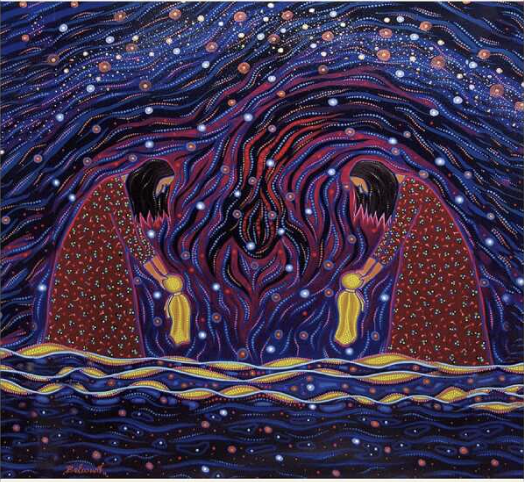
Ancestral Palimpsests
Ancestral work is powerful in that it can address the roots of both patriarchy and racism. It’s as if our long-ago ancestors hold out their arms to us, fastening us back to our Mother Earth–umbilicus, to each other and the entire web of life. This is the remembering and reintegration of a land-based identity that existed before the adoption of deleterious social constructs, and it wholly needs to be liberated from the vicissitudes of a patriarchal and colonized history.

Motherland
Reconnecting with the strengths and struggles within the ancestral homelands of settler colonialists is a critical step in healing the systems of violence and power over we have adopted and used to cause great destruction in America. But can you go home again? This non-fiction essay explores my quest to return home to Ireland, to the motherland. I explore some of the challenges and gifts I discovered in going home, including a transformational visit to the Cailleach, a goddess who bears witness to the living power of Ireland's ancient but ever potent matrifocal traditions.

Beloved White Kin, Now is the Time
This submission is the most important love letter I have ever written: an invitation to move beyond incremental gestures and towards deeper, accountable solidarity with Indigenous, Black, and other BIPOC communities. Written in the current political moment, it holds both hope and the hard-won skepticism of communities repeatedly betrayed by white supremacy, while calling for anti-racist education rooted in Indigenous leadership, truth-telling, accountability, and meaningful collective action.

Reparations as a Sacred Practice of Healing
This brief reflection considers reparations as an act of tikkun (a principle in Judaism meaning to repair or make whole), not only for those harmed by centuries of genocide and enslavement in what is now called the US, but for soul repair of the white-bodied perpetrators and beneficiaries of those harms.

a pain in the neck
This poem explores the manifestation of physical pain that has flared prior to Indigenous solidarity actions and my attempts to understand the root of the pain. As i sat with the restriction, i began to feel the presence of two ancestors who were part of the land theft that swept across Turtle Island. "a pain in the neck” shares a glimpse into the reckoning i had to move through so i could do the work that moves towards repair.

Healing Our Founding Pandemic
This story came to me during the pandemic while working on Inherited Silence and struggling to find loving ways to grieve our history, understand my Pilgrim ancestors, and heal the mind of the colonizer in myself and my lineage–all ongoing struggles in today's world. I'm grateful to Whatimiss.space, a website honoring a beautiful man who died in the AIDS epidemic, which published this story in 2020 and has given permission to republish it with several updated links. Regarding the setting of this story, I’m grateful to report that The Native Land Conservancy, a project of the Mashpee Wampanoag, has recently regained stewardship of the Cape Cod beach where my ancestors encountered and fired shots at the First People of this beautiful region.

Upon Looking at Photos of Sicily
It wasn’t until I was an adult that I understood how traumatic immigration had been for my nonna, my grandmother. I also witnessed how that trauma got passed down through the generations as well as the process of “becoming white.” My mother once told me that each member of our family made a choice – to embrace whiteness, forgetting all the prejudice they had endured as Sicilians or to remember what they had gone through and empathize with Black people and other people of color facing racism. She chose the latter path and instilled that in me.

In My Mother’s Garden
My essay traces how practices of care, solidarity, and political engagement moved through my family—from Sicilian immigrant traditions, through my mother’s interracial organizing and civil-rights work, and into my own political life. By placing those inheritances inside the history of racial formation in the United States, the piece asks what we carry forward, what we interrogate, and how inherited ways of belonging can be transformed into deeper anti-racist solidarity in the present.

Unicorns: A Memoir for Young White Men
Too often, our White antiracist spaces are missing men. And too often, it is extremists, the manosphere, and the Right that are not only more successfully recruiting White men, but influencing White boys. As White antiracist men, mentors, and educators, we hope this interview contributes to thinking about what White boys and young men need, and how we can nurture future generations of White boys and men in embodying lineages that are grounded in the love and respect for all peoples… and that support their own heath and happiness.

Confronting Lineage Curses: My Journey to My South Alabama Roots
I share this story of one of my pilgrimages to Alabama to show what's possible when we seek connection with problematic ancestors. White people who are on assignment to break generational curses need to leave breadcrumbs for each other because this is hard and hidden work. The white Southern racial justice organizer Anne Braden said, "You cannot organize people you hate." My ancestral journeys are helping me build a relationship with my people that moves past the twin curses of severance and denial. By seeking out our ancestors and building relationships with them grounded in love and rigor, we are the ones who will get our people's souls back.

Ancestor Dreams + For the Fire Gods
These paintings form a visual residue of my explorations into the pre-Christian spirituality of my European ancestors, reaching towards the collective consciousness of a time when “white people” were indigenous to specific places and revered rather than destroyed the land. They are my prayers and spells; they are my synesthetic responses to music and light; and they are improvisations based on the knots and rings of the raw wood underneath them.

Letters of Retrieval, of Reckon
Zoë and Geneva strongly believe in, and practice, writing as a tool to process, disrupt, unpack, and compost our colonial inheritances of whiteness, supremacy, and dominance, and as a necessary internal and collective process towards accountability and reparations. This piece is an excerpted letter exchange between Zoë and Geneva from the Summer 2026, as they wade through the muck and beauty of ancestral retrieval & reckoning—offering a vulnerable window into this accountability poetic practice as a commitment to ourselves, each other, our BIPOC kin, our future lineages, and to staying on the hook, in our writing and in our lives, wherever we go and whoever we are with.

Ancestral Recovery and Radical Diasporism: Beyond Dispersion to Solidarity
This essay argues that Ashkenazi ancestral recovery — reconnecting to suppressed Yiddishkayt and Diasporic culture — is inseparable from anti-racist and solidarity politics: when white-passing Jews heal our disconnection from our won heritage, we become more trustworthy, less extractive solidarity partners. Rooted in Radical Diasporism and the Bundist principle of doikayt (hereness), it offers a framework for Jewish identity that is explicitly anti-nationalist, committed to Indigenous solidarity, earth-rooted, and oriented toward collective liberation rather than ethnic insularity. At a moment when Jewish identity is being weaponized both to justify genocide and to suppress dissent, this piece builds on a long-buried Jewish political tradition that centers justice and belonging-in-place over state power.

Anti-Racism & Solidarity
Pieces by: David Dean, Janet Carter, Julie Wolk, J. Miakoda Taylor, Chris Crass, Catalyst Project, Tina Jeanette Szpicek, Kaia Svien, Leah Jo Carnine and Caroline Picker, Jennifer Jupiter, Echo & Tina

Immigration & Assimilation
Pieces by: Liza J. Rankow, Anna Blackshaw, Felicia Gustin, Monica Berini, Denise Alden, MJ Penizotto

Place, Ecology & Homelands
Pieces by: Lucy Waechter Webb, Lydia Breunig, Osprey Orielle Lake, Stevie Guiol-Moss, Dani Burlison, Erin Langley, Nora Murphy, Raven Hinojosa
Healing Ancestral Trauma
Pieces by: Susan Raffo, Kari Points, Louise Dunlap, iusti remer-thamert, Charlotzi Sáenz, Steve Jensen, Kelsey Lavoie, Joseph B. Shumway, kay zeiss, Julia Rhodes Davis, caroline kaufmann, Marisa Handler, Mel Baiser
Practices & Portals of Connection
Pieces by: Kusum Crimmel, Atava Garcia Swiecicki, Lauren Gucik, Re-calling our Ancestors, Hilary Giovale, Ream, Maija Danilova West, Kari Points, Jacks McNamara, Meg Yardley, Roan Coughtry and Wren Willsea
Reckoning & Reparations
Pieces by: Mary Watkins, Juliette Beck, Michelle Puckett, Amanda K. Gross, Pegi Eyers, Geneva Toland & Zoë Fay-Stindt, Justine Epstein, Lucy Waechter Webb, Liza J. Rankow, Karen Brown, Cindy Waszak Geary
Tending to Future Lineage
Lynn Burnett in conversation with Jason Biehl, Jeremiah Redwood and Menno
Schwartz
What does ancestral reconnection work have to do with anti-racism?
What does a racial justice lens bring to ancestral recovery work?
We at Ancestral Ground believe that regenerative, just futures are possible
We believe that a restorative connection to ancestry can support white people to engage in the work of repair with greater humility, humanity, vision and accountability. Under the myth and systems of white supremacy, profound violence is being committed against all our kin and the fabric of life. To resist and transform this violence, we are called to get to the roots of the long war on people and nature. There is an urgent need for white-identified people to collectively heal the erasures, harms, lies and ruptures of white supremacy that attempt to separate us from the potential of mutiracial class struggle, as well as the interconnected reality of all beings on Earth.
We believe a cultural resistance movement is essential to our collective survival. Culture shapes our sense of what is possible—it is through our stories, art, rituals, and relationships that we remember how to belong, how to resist, and how to reimagine a future rooted in justice and care for all beings. Ancestral Ground aims to amplify and fortify this cultural movement as a site for collective learning, remembering, and liberation.
What healing is ours to do, now?
Our task is to shake the amnesia…Our task is to honor our ancestors, even those who caved beneath the weight of systematic destruction and became conquerors themselves.
– Lyla June Johnston, The Vast and Beautiful World of Indigenous Europe